


Choosing the correct PVC sheet thickness is one of the most important decisions when designing packaging. While many buyers focus on material price or transparency, the thickness of the PVC sheet directly affects thermoforming performance, product protection, packaging appearance, and overall production efficiency.
A sheet that is too thin may reduce packaging strength and increase the risk of deformation, while a sheet that is too thick can raise material costs and reduce forming efficiency. Selecting the appropriate thickness requires balancing product protection, manufacturing requirements, and budget.
In this guide, we'll explain how PVC sheet thickness influences packaging performance and provide recommendations for different packaging applications.
1. Why PVC Sheet Thickness Matters
PVC sheet thickness affects nearly every stage of the packaging process, from thermoforming to transportation and final product presentation.
Choosing the correct thickness helps manufacturers achieve:
- Stable thermoforming performance
- Consistent blister cavity formation
- Better sealing performance
- Improved product protection
- Reduced material waste
- Lower production costs
For high-speed packaging lines, even small variations in thickness can affect forming consistency and machine efficiency. This is why professional packaging manufacturers pay close attention to both nominal thickness and thickness tolerance.
2. Common PVC Sheet Thickness Range
Packaging-grade PVC sheets are available in various thicknesses depending on the intended application.
| Thickness | Typical Applications |
|---|---|
| 0.15–0.20 mm | Small pharmaceutical blister packs |
| 0.20–0.30 mm | Tablets, capsules, healthcare products |
| 0.30–0.40 mm | Food trays, cosmetic packaging |
| 0.40–0.60 mm | Industrial packaging and protective trays |
| Above 0.60 mm | Heavy-duty packaging and custom thermoformed products |
The thicker the sheet, the greater its rigidity and impact resistance. However, increased thickness also means higher material consumption and longer forming cycles.
Instead of selecting the thickest material available, buyers should choose the thickness that best matches their packaging requirements.
3. Pharmaceutical Packaging
Pharmaceutical blister packaging requires excellent dimensional accuracy and sealing performance. The PVC sheet must maintain consistent thickness to ensure uniform cavity formation and reliable heat sealing with aluminum foil.
Typical requirements include:
- High transparency
- Stable thermoforming
- Excellent flatness
- Tight thickness tolerance
- Consistent batch quality
Most pharmaceutical blister packaging uses PVC sheets between 0.20 mm and 0.30 mm, depending on tablet or capsule size.
Choosing the appropriate thickness helps improve production efficiency while minimizing waste during high-speed packaging.
4. Food Packaging
Food packaging often requires a balance between product protection, presentation, and cost control.
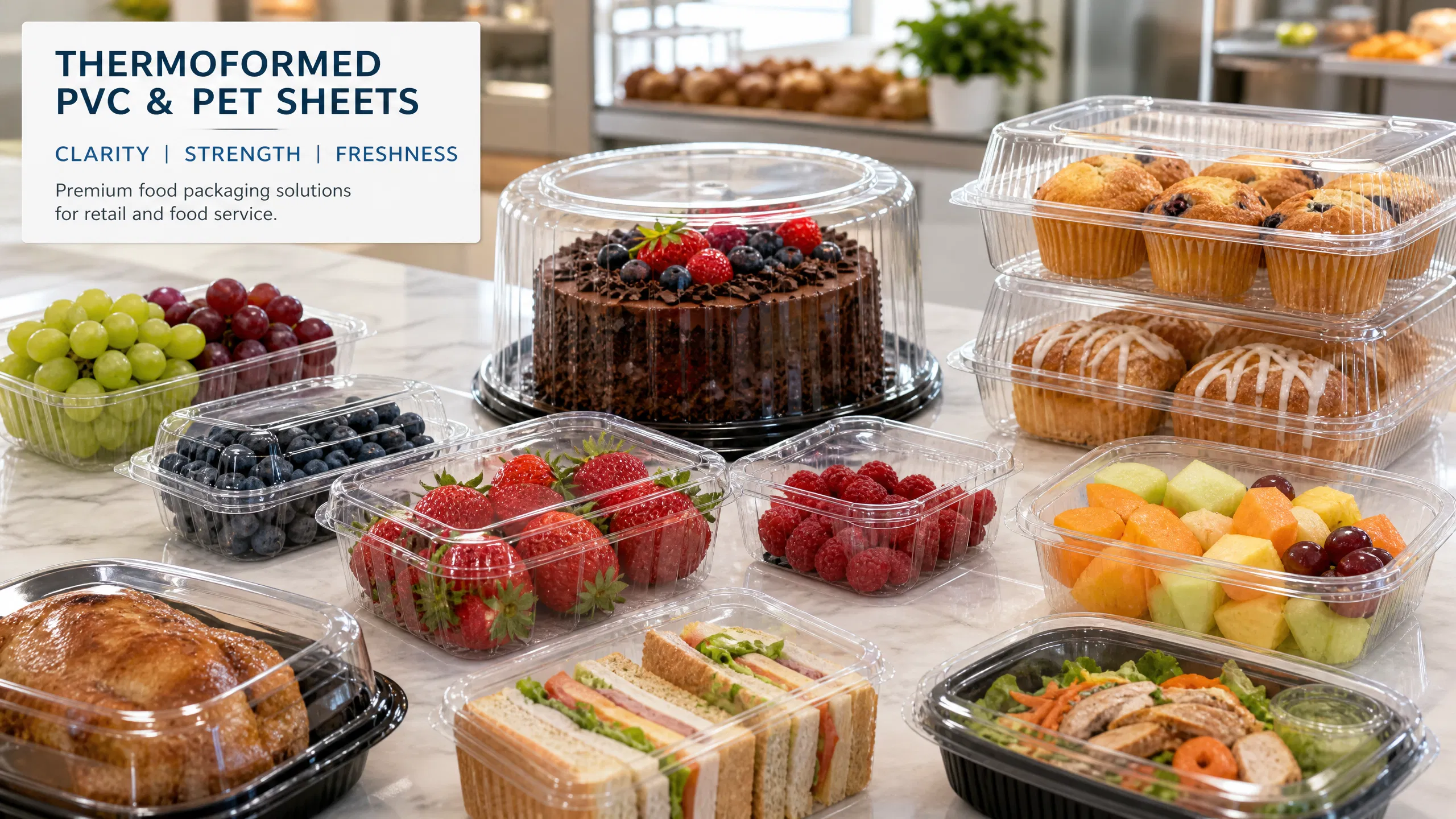
Fresh food trays, bakery containers, fruit packaging, and disposable food boxes generally require greater rigidity than pharmaceutical packaging.
Typical thickness ranges include:
- 0.30–0.50 mm for thermoformed food trays
- 0.40–0.60 mm for rigid food containers
The ideal thickness depends on several factors:
- Product weight
- Transportation distance
- Stacking requirements
- Shelf display appearance
For premium food packaging, manufacturers may also consider PET materials that offer excellent clarity and recyclability for certain applications.
5. Cosmetic Packaging
Cosmetic packaging places greater emphasis on appearance and presentation. The packaging must not only protect the product but also enhance shelf appeal.
PVC sheets used for cosmetic packaging should provide:
- High transparency
- Smooth surface finish
- Good gloss
- Excellent thermoforming performance
- Scratch resistance
Common thicknesses range from 0.25 mm to 0.45 mm, depending on product size and package design.
For premium cosmetic products requiring exceptional clarity, some manufacturers also choose PETG sheets as an alternative material for high-end display packaging.
6. Industrial and Electronics Packaging
Industrial components, electronic accessories, hardware tools, and consumer products often require stronger packaging to withstand transportation and handling.
PVC sheets used for these applications generally range from 0.40 mm to 0.80 mm, providing greater rigidity and impact resistance.
When selecting thickness, buyers should evaluate:
- Product weight
- Drop resistance requirements
- Transportation conditions
- Storage environment
- Packaging automation requirements
Selecting a sheet that is unnecessarily thick increases production costs without providing additional value, while a sheet that is too thin may result in damaged products during shipping.
7. How Thickness Affects Thermoforming Performance
Selecting the correct thickness is not only about product strength-it also has a direct impact on thermoforming efficiency.
If the PVC sheet is too thin, it may stretch excessively during forming, resulting in uneven wall thickness, weak corners, or deformation. On the other hand, an overly thick sheet requires more heating time and forming pressure, which may reduce production speed and increase energy consumption.
A properly selected thickness helps manufacturers achieve:
- Consistent blister cavity formation
- Uniform wall thickness
- Faster production cycles
- Better sealing performance
- Reduced material waste
For manufacturers operating high-speed packaging lines, stable thermoforming performance is just as important as the sheet's physical properties.
8. Thickness Tolerance Is Just as Important as Thickness
Many buyers compare suppliers based only on the nominal thickness of the PVC sheet. However, thickness tolerance is often the more critical factor.
For example, a PVC sheet specified as 0.30 mm with poor thickness consistency may actually vary throughout the roll. These variations can cause inconsistent forming depths, unstable sealing, and higher rejection rates.
A reliable PVC sheet manufacturer should be able to maintain tight thickness tolerances throughout production, ensuring consistent performance from the beginning to the end of each roll.
When evaluating suppliers, consider asking about:
- Thickness tolerance standards
- Thickness inspection methods
- Online quality monitoring
- Batch-to-batch consistency
Consistent thickness contributes to smoother production, fewer machine adjustments, and improved product quality.
9. How to Balance Cost and Performance
Choosing a thicker PVC sheet does not always result in better packaging. Likewise, selecting the thinnest material simply to reduce costs may lead to product damage or increased production waste.
Instead of focusing only on material price, buyers should evaluate the total cost of packaging, including:
- Material consumption
- Production efficiency
- Scrap rate
- Transportation protection
- Customer satisfaction
- Long-term packaging performance
In many cases, selecting the most suitable thickness-not necessarily the thickest or the cheapest-provides the best overall value.
10. Questions Buyers Should Ask Before Choosing PVC Sheet Thickness
Before placing a bulk order, it is helpful to discuss the following questions with your supplier:
- What products will be packaged?
- What forming equipment will be used?
- Is the packaging intended for pharmaceutical, food, cosmetic, or industrial applications?
- What level of rigidity is required?
- Will the packaging experience long-distance transportation?
- Is high transparency important?
- Are there any special sealing requirements?
An experienced supplier can recommend the most appropriate thickness based on your production process and application rather than simply offering a standard specification.
11. When Should You Consider Other Materials?
Although PVC remains one of the most widely used thermoforming materials, certain applications may benefit from alternative materials.
For example:
- PET sheets provide excellent clarity, strength, and recyclability, making them suitable for food packaging and consumer products.
- PETG sheets offer excellent impact resistance and superior transparency, making them ideal for premium cosmetic packaging, medical packaging, and display applications.
Selecting the right material should always be based on product requirements, processing conditions, regulatory standards, and budget.
Conclusion
Choosing the right PVC sheet thickness is essential for achieving reliable thermoforming, effective product protection, and efficient packaging production. By matching the material thickness to your specific application, you can improve packaging quality while optimizing production costs.
At Jinfeng New Material, we provide high-quality PVC sheets, PVC films, PET sheets, and PETG sheets for pharmaceutical, food, cosmetic, and industrial packaging. With over 20 years of manufacturing experience, we offer customized solutions to meet a wide range of packaging requirements.
Contact us to discuss your project or request samples for evaluation.