


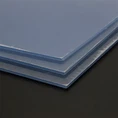


Flexural modulus, also known as the bending modulus, is a crucial mechanical property that measures a material's stiffness when subjected to bending forces. In the context of transparent PVC sheets, understanding the flexural modulus is essential for various applications, from advertising to construction. As a leading supplier of transparent PVC sheets, we are well - versed in the significance of this property and its impact on product performance.
Understanding Flexural Modulus
The flexural modulus is determined through a three - point or four - point bending test. During the test, a sample of the transparent PVC sheet is placed on two support points, and a load is applied at the center (in a three - point test) or at multiple points (in a four - point test). The resulting deflection of the sheet is measured, and the flexural modulus is calculated using the applied load, the dimensions of the sample, and the measured deflection.
Mathematically, the flexural modulus (E) can be expressed as:
[E=\frac{L^{3}F}{4bh^{3}\delta}]
where (L) is the span length between the supports, (F) is the applied load, (b) is the width of the sample, (h) is the thickness of the sample, and (\delta) is the deflection at the center of the span.
A higher flexural modulus indicates that the transparent PVC sheet is stiffer and more resistant to bending. Conversely, a lower flexural modulus means the sheet is more flexible and will bend more easily under the same load.
Factors Affecting the Flexural Modulus of Transparent PVC Sheets
1. PVC Resin Type
There are different types of PVC resins available, and each has its own inherent properties. For example, suspension PVC resin is commonly used in the production of transparent PVC sheets. The molecular weight and structure of the resin can significantly influence the flexural modulus. Higher molecular weight PVC resins generally result in sheets with a higher flexural modulus because the longer polymer chains provide more resistance to deformation.
2. Additives
Additives are often incorporated into PVC formulations to enhance specific properties. Plasticizers, for instance, are used to increase the flexibility of PVC sheets. However, the addition of plasticizers reduces the flexural modulus because they disrupt the intermolecular forces between the PVC polymer chains. On the other hand, fillers such as calcium carbonate can increase the flexural modulus. Fillers act as reinforcing agents, providing additional stiffness to the sheet.
3. Sheet Thickness
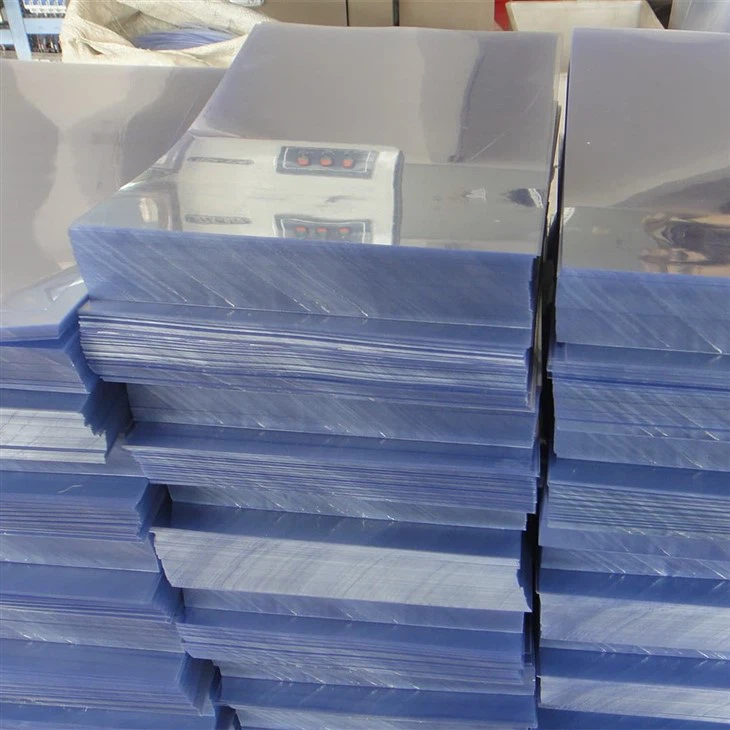
Thicker transparent PVC sheets typically have a higher flexural modulus compared to thinner ones. This is because the increased thickness provides more material to resist the bending forces. When designing applications that require high stiffness, choosing a thicker sheet can be an effective solution.

4. Manufacturing Process
The manufacturing process of transparent PVC sheets also plays a role in determining the flexural modulus. Extrusion is a common method for producing PVC sheets. The processing conditions, such as temperature, pressure, and screw speed, can affect the orientation of the polymer chains in the sheet. A well - oriented polymer structure can result in a higher flexural modulus.
Importance of Flexural Modulus in Different Applications
Advertising
In the advertising industry, Hard PVC Sheet For Advertising is widely used for creating signs, displays, and banners. A high flexural modulus is desirable in these applications because it ensures that the sheets maintain their shape and do not sag or deform over time. This is especially important for large - scale outdoor advertisements that are exposed to wind and other environmental factors.
Construction
For construction purposes, Thick Transarent PVC Sheet Used For Building Material is used in applications such as partitions, skylights, and window glazing. The flexural modulus is a critical property in these applications as it determines the structural integrity of the sheets. Sheets with a high flexural modulus can withstand the weight of snow, wind loads, and other external forces without breaking or deforming.
Office and Stationery
Hard Transparent PVC A4 Sheet is commonly used in office settings for document protection, presentation folders, and other stationery items. A suitable flexural modulus is necessary to ensure that the sheets are stiff enough to hold their shape but also flexible enough to be easily handled.
Our Transparent PVC Sheets and Flexural Modulus
As a supplier of transparent PVC sheets, we understand the importance of controlling the flexural modulus to meet the specific requirements of our customers. We carefully select the PVC resin and additives to achieve the desired balance between stiffness and flexibility. Our manufacturing process is optimized to ensure consistent quality and a uniform flexural modulus across all our products.
We offer a wide range of transparent PVC sheets with different flexural modulus values to cater to various applications. Whether you need a stiff sheet for outdoor advertising or a more flexible one for stationery, we have the right product for you. Our technical team is also available to provide expert advice on selecting the most suitable sheet based on your specific needs.
Contact Us for Your Transparent PVC Sheet Needs
If you are in the market for high - quality transparent PVC sheets with the right flexural modulus for your application, we invite you to contact us. Our dedicated sales team is ready to assist you in finding the perfect product and providing you with a competitive quote. We are committed to delivering the best products and services to our customers, and we look forward to partnering with you for your transparent PVC sheet requirements.
References
- "Plastics Engineering Handbook of the Society of Plastics Engineers"
- "Polyvinyl Chloride (PVC): Properties, Processing, and Applications"
- ASTM D790 - Standard Test Methods for Flexural Properties of Unreinforced and Reinforced Plastics and Electrical Insulating Materials